
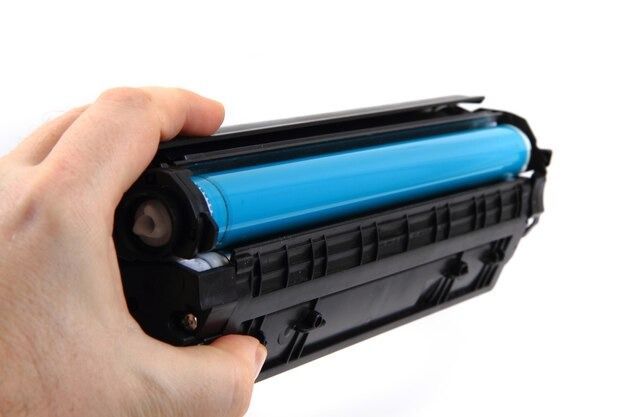
Toner cartridges look like a small line on the budget. Add up a year of them across every printer in the office, though, and the total can easily rival what the printers cost. The frustrating part is that much of that money pays for packaging and brand names, not for pages.
This guide is for office managers, business owners and home-office users who buy toner regularly. It explains the cartridge types on the market, how to compare them fairly, and how to choose a supplier you can rely on. It uses real prices so you can check the maths yourself.
Quick answer: To buy toner cartridges without overpaying, compare cost per page, not the sticker price. Divide the cartridge price by its rated page yield. High-yield cartridges and quality compatible cartridges usually give the lowest cost per page, often less than half the cost of standard genuine cartridges, without changing your printer or your print quality.
What Types of Toner Cartridges Can You Buy?
There are four main types of toner cartridges: genuine (OEM), compatible, remanufactured, and specialty cartridges such as MICR and TAA-compliant toner. They all fit the same printers. They differ in who makes them, what they cost, and which jobs they suit.
Type | What it is | Typical cost | Best for |
|---|---|---|---|
Genuine (OEM) | Made by the printer brand, such as HP, Brother or Canon | Highest | Leased printers or policies that require OEM supplies |
Compatible | A new cartridge made by a third party to fit the printer | Lowest per page | Everyday office and home printing |
Remanufactured | A used genuine shell, cleaned, refilled and rebuilt | Low | Buyers who want reuse and a lower price |
MICR | Toner with magnetic particles | Above standard | Printing cheques and bank documents |
TAA-compliant | Made in countries approved under the US Trade Agreements Act | Varies | US government and GSA contracts |
Genuine vs compatible: what really changes?
The printer brand designs genuine cartridges and charges a premium for its name and retail channel. A quality compatible cartridge is built to the same page yield and fits the same slot. In practice, the main differences for a buyer are price, warranty and who you call if something goes wrong.
What does "IP compliant" mean?
An IP-compliant cartridge is designed so it does not copy the printer maker's patented parts. That matters for businesses because it reduces legal risk for the seller and supply disruptions for you. Look for this label on HP and Lexmark compatibles in particular.
When do you need MICR toner?
You need MICR toner if you print your own cheques. Banks in Canada and the US read the account and routing numbers at the bottom of a cheque magnetically. Regular toner cannot be read that way, so cheques printed with it can be rejected.
Who needs TAA-compliant toner?
US federal agencies and many contractors must buy products made in the US or in countries designated under the Trade Agreements Act. If you bid on GSA or government work, ask your supplier for TAA-compliant cartridges and documentation.
How Do You Calculate the Cost Per Page of a Toner Cartridge?
To calculate cost per page, divide the cartridge price by its rated page yield. A C$72.95 cartridge rated for 3,100 pages costs about 2.4¢ per page. This single number lets you compare any two cartridges fairly, whatever their size or brand.
Cost per page = cartridge price ÷ rated page yield
What "page yield" actually means
Page yield is the number of pages a cartridge prints in a standard test. Black toner is measured under ISO/IEC 19752 and colour toner under ISO/IEC 19798. Both assume about 5% of the page is covered, roughly a short business letter. Pages with logos, photos or dense tables use more toner, so your real yield may be lower. Use the rated yield to compare cartridges, not to predict an exact page count.
Real cost-per-page examples
These examples use prices from Canadian retailers and our own store, checked in October 2026.
Cartridge | Rated yield | Genuine price → cost per page | Compatible price → cost per page |
|---|---|---|---|
HP 26A (CF226A) | 3,100 pages | C$227.99 → ~7.4¢ | C$72.95 → ~2.4¢ |
Brother TN760 | 3,000 pages | ~C$103 → ~3.4¢ | C$65.95 → ~2.2¢ |
HP 58X (CF258X) | 10,000 pages | C$280–C$375 → ~2.8¢–3.7¢ | C$274.95 → ~2.7¢ |
Genuine prices come from single Canadian retail listings and vary by store and week.
Standard yield vs high yield
High-yield cartridges, usually marked with an X or a higher number, almost always cost less per page. Our compatible HP 58A (CF258A) costs about 4.7¢ per page. The high-yield 58X costs about 2.7¢. That is roughly 41% less for the same printer. If you print every day, high yield is the easiest saving you can make.
How to budget toner for a year
Multiply your monthly page count by 12, then by your cost per page. An office printing 2,000 pages a month at 2.5¢ per page spends about C$600 a year on toner. At 7¢ per page, the same office spends about C$1,680. Most printers show their total page count on a status or configuration page, which makes this easy to measure.
How Do You Choose the Right Toner for Your Printer?
Start with your exact printer model, then find the cartridge number it uses, then pick the yield that matches how much you print. Getting the model right is the step that prevents most wrong orders and returns.
- Find your printer model. It is printed on the front panel or on a label inside the front cover, for example "HP LaserJet Pro M404dn" or "Brother HL-L2350DW".
- Find the cartridge number. Check the old cartridge, the printer manual, or a supplier's compatibility list. HP uses codes like CF258A, Brother uses codes like TN760, and Canon uses numbers like 054.
- Choose standard or high yield. Under about 250 pages a month, standard yield is fine. Above that, high yield saves money.
- Check for a separate drum. Most HP cartridges include the drum. Many Brother printers use a separate drum unit that lasts for several toner cartridges.
- For colour printers, decide single or set. Black usually runs out first, so buy it on its own. Buy a full colour set when all colours are low.
Brand-by-brand tips
- HP: most LaserJet cartridges include the drum. Some newer HP models can block non-HP chips after a firmware update, so read the firmware section below. Shop HP toner cartridges.
- Brother: toner and drum are usually separate. Replacing the drum on schedule keeps print quality sharp. Shop Brother toner cartridges.
- Canon: imageCLASS colour models use four separate cartridges, often with standard and high-yield ("H") versions, such as 054 and 054H. Shop Canon toner cartridges.
Using an inkjet printer? Inkjets use ink, not toner. Our guide to HP ink vs toner cartridges explains which one your printer needs.
What Should You Look for in a Toner Supplier?
A good toner supplier gives you a clear cost per page, a written warranty, accurate compatibility information, and a real person to contact when something goes wrong. Price matters, but a cheap cartridge that fails or leaks costs more than it saved.
The 8-point supplier checklist
- Clear page yield stated for every cartridge, at 5% coverage
- Written warranty that says exactly what happens if a cartridge fails: exchange, refund or both
- Compatibility list by printer model on each product page
- Quality standards such as ISO 9001 for quality and ISO 14001 for environmental management
- Working chips and a plan if a printer update rejects them
- Fast shipping with tracking, and a free-shipping threshold that suits your order size
- Real contact details: a phone number and email that people actually answer
- Specialty options if you need them, such as MICR or TAA-compliant toner
Red flags to avoid
- No page yield listed, or a yield far above the genuine cartridge's rating
- No warranty, or a warranty that only covers "defects" without saying what counts
- Prices so low that the cost per page is a fraction of every other seller
- No way to contact the seller other than a marketplace message box
How Premium Toners measures up
Our product pages list page yield and compatible printer models. Our premium cartridges are built with Static Control technology in ISO 9001:2015 and ISO 14001:2015 compliant production, and we carry IP-compliant, MICR and TAA-compliant lines. Orders over $49 ship free to Canada and the US. If a cartridge does not work, we exchange or refund it.
How Should a Business Manage Toner Across the Office?
The simplest system is to keep one spare cartridge per printer, store it properly, control printer firmware updates, and recycle empties. That avoids downtime, wasted toner and surprise blocks from printer updates.
Keep one spare per printer
Order a replacement when the printer first shows "Toner Low", not when it stops. For busy printers, keep one spare on the shelf at all times. Standardizing on fewer printer models also helps, because one cartridge type can then cover several machines.
Store toner the right way
- Keep cartridges sealed in their bags until you need them
- Store them flat, in a cool, dry place away from direct sunlight and heaters
- Use them within about two years of purchase
- Gently rock a new cartridge side to side before installing it to spread the toner
Control printer firmware updates
Some printer makers use firmware updates to check cartridge chips. HP's "Dynamic Security" updates have stopped some LaserJet models from accepting non-HP chips. In 2025, HP settled a US class action by agreeing to make those updates optional on affected models. Set office printers to manual or "notify only" updates, and install updates when you choose to.
Recycle empty cartridges
Never put toner cartridges in household or office trash. Use a toner recycling drop-off, an office supply store program, or the printer brand's return program. Choosing compatible or remanufactured cartridges and recycling empties both reduce waste.
Toner Cartridge Buying FAQs
What is the cheapest way to buy toner cartridges?
The cheapest way is to buy high-yield compatible toner cartridges from a supplier with a clear warranty. High-yield cartridges cost less per page, and quality compatibles usually cost far less per page than standard genuine cartridges.
Are compatible toner cartridges safe for my printer?
Yes. A well-made compatible cartridge is built to fit and work like the original and does not harm the printer. The risks come from poor chips or seals, so buy from a seller who lists page yields and stands behind every cartridge.
Do compatible toner cartridges void my printer warranty?
In the US, the Magnuson-Moss Warranty Act generally stops a manufacturer from voiding a warranty just because you used third-party supplies. In Canada, check your printer's warranty terms. A maker may still refuse to cover damage it can show a faulty cartridge caused.
How long does a toner cartridge last?
A toner cartridge lasts for its rated page yield, usually 1,000 to 10,000 pages depending on the model and yield. Unopened cartridges keep for about two years when stored sealed, flat and away from heat.
What is the difference between toner and ink?
Toner is a dry powder used by laser printers and fused to paper with heat. Ink is a liquid used by inkjet printers. Toner usually prints more pages per cartridge and costs less per page for text documents.
What does the "X" mean in a toner cartridge number?
On HP cartridges, an "X" usually means high yield, for example CF258X versus the standard CF258A. Canon often uses "H", such as 054H. Brother uses different numbers, such as TN730 for standard and TN760 for high yield.
Why does my printer reject a new toner cartridge?
The printer may not be reading the cartridge chip, or a firmware update may be blocking non-brand chips. Reseat the cartridge first. If the message stays, contact your supplier for an exchange and switch the printer's firmware updates to manual.
Can I buy toner for several printer brands from one supplier?
Yes. Many suppliers, including Premium Toners, carry cartridges for HP, Brother, Canon, Dell, Lexmark, Samsung, Xerox and more. Buying from one supplier simplifies ordering and billing for offices with mixed printers.
How much toner should a small office keep in stock?
Keep one spare cartridge for each printer model you use, plus a full colour set for busy colour printers. Reorder as soon as a spare goes into a printer.
Is remanufactured toner the same as compatible toner?
No. A remanufactured cartridge reuses a genuine shell that has been cleaned and refilled. A compatible cartridge is newly built by a third party. Both can perform well when made to a good standard.
Buy Toner Cartridges by Cost Per Page, Not by Price Tag
The smartest way to buy toner cartridges is simple: know your printer model, compare cost per page, choose high yield when you print often, and buy from a supplier with a clear warranty. Those four habits can cut a typical office toner bill by half or more, as the real examples above show, without changing a single printer.
Ready to start? Find your cartridge in our HP, Brother or Canon collections, or start with popular picks like the compatible HP 26A (CF226A) and the compatible Brother TN760. Orders over $49 ship free to Canada and the US.
Buying for a whole office, or need MICR or TAA-compliant toner? Call (514) 993-4142 or email [email protected]. Tell us your printer models and monthly page counts, and we will recommend the lowest cost-per-page option for each one.