
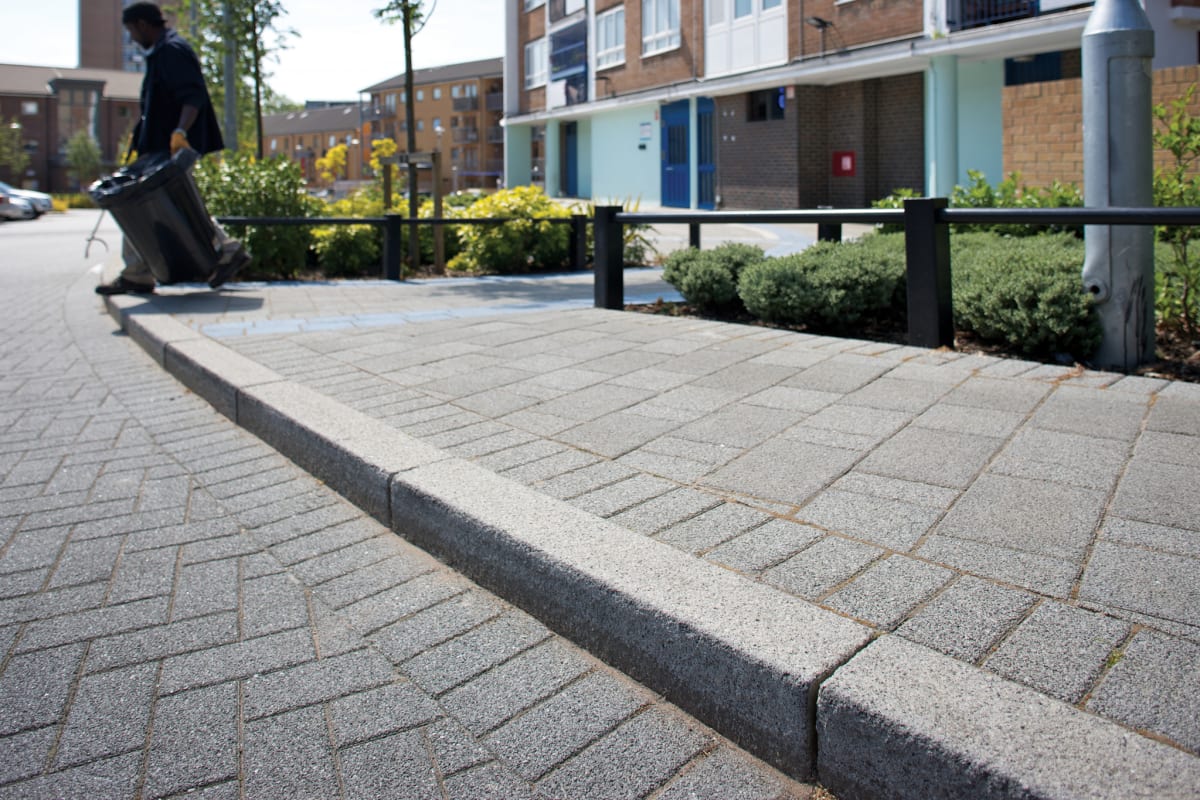
Accessing a private driveway from a public road requires more than simply laying a surface — it requires a legal and correctly constructed crossing point between the carriageway and your property. A and M Groundworks works with homeowners and developers across the region to install properly approved drop kerbs that meet highway authority standards and provide safe, durable vehicle access. Whether you are creating a new driveway, widening an existing access, or converting a front garden for off-road parking, understanding the full process — from application to installation — is essential before any work begins.
What a Drop Kerb Is and What It Does
A drop kerb, also referred to as a vehicle crossover or lowered kerb, is a section of the pavement and kerbing that has been lowered to allow vehicles to cross from the public highway onto private land. The kerb is ramped down from standard height to road level, and the footway surface is reinforced to withstand the weight of vehicles passing over it. Without a properly constructed drop kerb, driving a vehicle over a standard kerb causes damage to the pavement and can make the property owner liable for repair costs.
The Legal Requirement for an Approved Crossing
In the United Kingdom, the public footway and carriageway are maintained by the local highway authority. Any alteration to these surfaces, including the installation of a drop kerb, requires the formal consent of that authority. Carrying out a vehicle crossover without approval is a criminal offence under the Highways Act 1980, and the council has the power to issue a notice requiring the crossing to be removed and the pavement reinstated at the property owner's expense.
The Application Process for Drop Kerb Approval
The application process varies slightly between different local authorities, but the general procedure is consistent across the country. An application must be submitted to the highways department of the relevant council, accompanied by details of the proposed crossing location, dimensions, and any associated driveway works. The council will assess the application against a set of standard criteria before granting or refusing permission.
Factors the Council Considers During Assessment
Highway authorities assess a range of factors when reviewing a drop kerb application. These include the visibility splay from the proposed access point — whether drivers exiting the property can see approaching traffic clearly — the proximity to junctions, bus stops, pedestrian crossings, and street furniture, and whether the proposed driveway surface is permeable or will discharge surface water onto the public highway. Applications near busy junctions or on classified roads are subject to greater scrutiny.
Timescales and Council Fees
Once an application is submitted, processing times typically range from four to twelve weeks, depending on the authority and the complexity of the proposal. Most councils charge a fee for the assessment and, in many cases, require that the physical drop kerb installation itself is carried out by their own approved contractor or by a licensed highway contractor. It is important to clarify this requirement with your local authority before appointing any contractor to avoid duplication of work or non-compliance.
What the Physical Installation Involves
The installation of a drop kerb involves breaking out and removing the existing full-height kerbing and footway surface over the required width, excavating to the correct depth, and constructing a new reinforced crossing with appropriately graded kerb units. The footway surface is reinstated using materials that match the existing highway, and the kerb units are haunched in concrete to ensure they remain stable under repeated vehicle loading.
Width and Gradient Specifications
The minimum width for a single vehicle crossover is generally 2.7 metres, with most standard residential crossings being between 3 and 4.5 metres wide. The gradient of the crossing must allow vehicles to pass over it without grounding, and the transition between the carriageway and the private driveway surface must be smooth and properly drained. These specifications are defined in the highway authority's standards and must be adhered to strictly for the installation to be approved.
Regional Considerations and Variations
How Requirements Differ Across Local Authorities
While the legal framework governing drop kerb installations is consistent across England and Wales, individual councils apply their own additional standards and requirements. For instance, dropped kerbs in Devon are subject to Devon County Council's highways standards, which specify particular materials, construction depths, and drainage requirements suited to the region's road network and ground conditions. Working with a contractor familiar with the relevant local authority's requirements avoids costly mistakes and ensures the installation passes inspection first time.
Impact of Road Classification on Approval
Properties fronting onto classified roads — A roads, B roads, and some C roads — face more stringent requirements than those on unclassified residential streets. In some cases, access onto a classified road may be refused entirely if it is deemed to create an unacceptable highway safety risk. Contractors and applicants should establish the classification of the fronting road before committing to a scheme, as this will determine whether the application is likely to succeed.
Conclusion
A drop kerb installation is a straightforward process when handled correctly, but the legal and technical requirements involved mean it should always be approached through the proper channels. A and M Groundworks ensures that every crossover is installed to the correct specification, with full compliance with the relevant highway authority's standards — giving property owners safe, lasting vehicle access without the risk of enforcement action.